
by Greg Fisher
February 5, 2023
If you hang around schools long enough, you will hear the term “engagement” so often it will eventually lose its meaning. “We need to engage students in the learning process” is the common refrain. Although I don’t disagree with the impulse, let’s be clear here. All the courses’ students take in elementary and middle school are compulsory. There is no survey for what students want to learn. No deviating from the prescribed state standards for the most part. In high school, the vast majority of courses that students take are also mandated, per State Ed. Code, coupled with the required minimum of instructional daily minutes, leaving very little room for supplanting additional elective courses. But no matter the class, the expectation now is that students are to be engaged in the learning process. There are types of student engagement that tap into cognitive, affective, and behavioral categories but in essence they are all interrelated. There are key elements of engagement such as student confidence, teacher involvement, relevant texts, and choice among texts and assignments. But in the end, it comes down to what is of real internal interest to our students and more importantly, what can an education provide that will result in adding value to the the skills, knowledge and experiences (Human capital) necessary for meeting their goals in life.

Overall, this is a good thing. We want students to be engaged and stimulated so that their motivation can be elevated to maintain a heightened learning posture and actively participate in the acquisition of new knowledge and skills. Activities designed to engage students, in and of themselves, don’t always being it home and deliver the results you want. It takes an effective and dynamic teacher who guides and facilitates the learning process, that determines how engaged the students become. As a teacher, I always had my radar turned on full blast to make sure that every student in the room was fully present and involved in whatever was happening or asked of them. And because much of my pedagogy was to place students in group modalities, and get myself out of the way, the challenge was to ensure that activities and projects were incentivized so that students would police themselves and make sure that each was pulling their weight. Sometimes it was using my personality and the relationship I had with students that made the difference. Using humor, caring behavior, or just my role as the authority in the room that got everyone on the same page.
But the real issue today is how can we provide students with what they want to learn and also expose them to curriculum that we know they will need to use in their everyday lives that is not in the state standards. We must do this for two primary reasons: First, when given the freedom to choose and have some say in what is decided they will be learning, we get students to invest in the process of them developing their human capital. Instead of obediently following for most of their lives what others expect and want for them to learn (obviously state content standards were written for good reasons), they are given a modicum of freedom to select topics that are of interest to them. Remember, sometimes it doesn’t matter what the subject is. The fact that students acquire 21st century skills such as critical thinking, creativity, collaboration, research and analysis, problem solving, information and technology literacy is way more important that the content of the subject itself. Moreover, student choice is at the heart of self-directed learning. When you have choice, you have ownership. Ownership means you value it. When you value something, you engage with it. When you are engaged with something, you will learn. It’s as simple as that.

Secondly, there are so many essential life skills that are not taught in schools that should be part of the mandated curriculum. These include learning communication and interpersonal relationships, media literacy, Economic reasoning & financial fluency, character education, and cultivating an entrepreneurial mindset. Of course, the list can grow longer. Topics that go into health and well-being, time management, environmental awareness, basic first-aid, how to cook, how to act in a job interview, basic home and car repair maintenance, sending professional email, etc. But the key is to prioritize your list and then execute.
There are specific ways in which to boost student engagement. ‘Flow Theory’ proposes that when one is actively engaged in an activity where the skills possessed are balanced to the challenge of the activity, s/he can approach an optimal state of experience called “flow.” Several conditions contribute to this psychological state. The five core examples include embracing student choice and agency, helping students monitor progress, taps into intrinsic motivation, minimizes distractions, and provides scaffolding. The flow model and related research provides a solid base of knowledge regarding how students might become more engaged in their learning and how they feel when they are so engaged. This knowledge base is of practical use to educators interested in increasing student engagement. But these are the tactics a teacher can deploy to set the foundation for engagement. I don’t doubt their pedagogical efficacy, but I believe student choice and exposure to essential life skills have more weight in the engagement calculus.
I spent most of my teaching career at the high school level teaching 12th graders. Since they were 17 and 18 years old, I inevitably had the discussion with them about they were on the precipice of making heavy duty life decisions that would alter the course and direction of their lives. What would they become in terms of a career? Where would they live? Who they would get involved with and commit to a long-term relationship and possibly raise a family? I tried my best to get them to learn concepts of Economic reasoning so they could make informed decisions on using scare resources in order to achieve their goals. With all of the misinformation and conspiracy theories permeating the airwaves and brainwashing young minds on social media, I integrated tools to help students become more media literate to help them detect false and misleading information. As part of a Student Assistance Program, I trained students in how to actively listen and provide emotional support for one another to help them be better at communicating and being in healthy relationships. For the California Council of Economic Education, I designed the Financial Advisor’s Contest, which my students participated in, to help them better understand the world of financial investing so they can grow and protect what they will be earning in their future. As part of a 9th-grade curriculum, all students entering our high school had to take a community college level course that helped them develop an entrepreneurial mindset. The purpose of the course was not to turn them into entrepreneurs and set up a business but rather to empower them to solve problems (mostly non-financial) that will inevitably come up in their lives. So, students learned concepts including react vs. respond, locus of control, leadership, resilience, and other skills that give the students the wherewithal to take care of life’s struggles as opposed to raising the white flag and surrendering, waiting for someone else to come to their rescue.

All of these skills to be taught require time. So, you have to decide what is to be sacrificed on the curriculum alter. But just sticking to the traditional array of required courses without giving students choices or in my case, creatively embedding courses that I know they will benefit from, was not an option. I knew that these are the things that all kids must learn to help them live in this world. The fact that I was working with inner-city communities made this all the more urgent. As a social class issue, I could see that parents living in economically depressed neighborhoods had less resources to provide for their children. This is why schools in urban areas that deal with so many challenging dynamics have a greater responsibility to provide an education that covers a wider range of deficits and limitations.
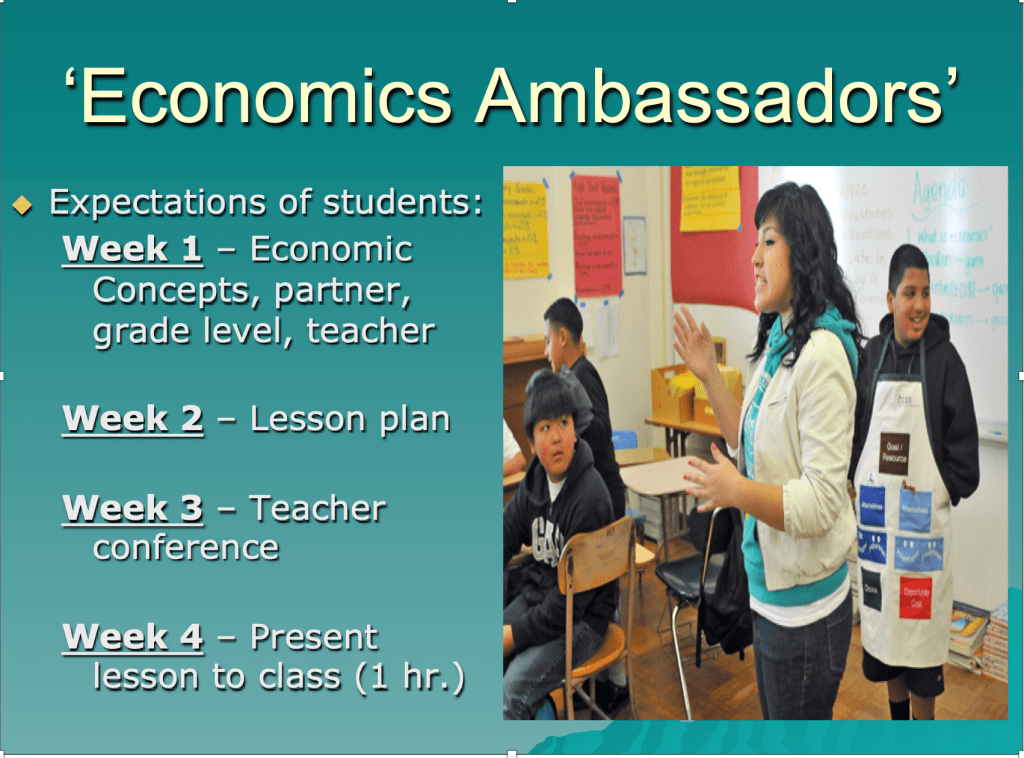
As a teacher, I was always coming up with new projects for students to work in pairs or groups in. My primary goals was to put them in learning situations where the process of discovery, self-confidence, essential skill building came together. After providing them with will all of the necessary resources and front-loaded instruction to get going, I would set them off on an adventure, tapping into multiple skill development including research, critical thinking, collaboration, making presentations, etc. An example of this was in my Economics class, students had to select one project among five offered (Video, Song, PowerPoint Presentation, Research, and Tutorial). It was called ‘The Econ Variety Show.’ Of course all students had the freedom to choose their project, but I always tried to nudge and persuade them to pick the tutorial where they had the opportunity to teach and hour of Economic Reasoning (benefit-cost analysis, opportunity costs, scarcity, marginal analysis, and human capital) to elementary and/or middle school students. They had top create a full-blown lesson plan, meet with the teacher in a pre-teaching conference, and then deliver an lesson for an hour on what they had learned in my Econ class. Us teachers know better than anyone that true mastery is when you can teach a topic, right? Over a 16-year period over 10,000 students were serviced by my Economics Ambassadors. For all of them, this “students-teaching-students” project became an unforgettable experience. They would return to class beaming from ear to ear, so blown away by how they were received, how taking over an entire classroom boosted their self-esteem, and what a powerful real-world moment it was not just in their own lives but in the class of students they taught.
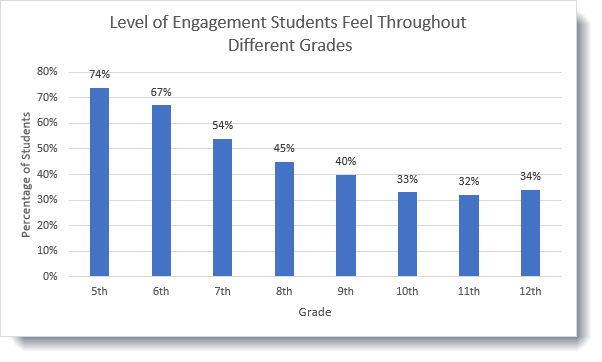
Students who are engaged are more hopeful for the future and are more likely to perform better in school. Hope is the belief that the future will be better than the present, coupled with the belief that you have the power to make it so. Students who are disengaged tend to feel discouraged about their future and begin to lack hope. When students begin to lack hope, they tend to disengage impacting their academic performance. We know that engagement is linked to student success, yet student engagement drops significantly from elementary to high school. While 74% of fifth-grade students find school engaging, that number drops to 34% for 12th graders in what Gallup calls the student engagement cliff.
An introductory survey is a great place to start learning about your students and their interests. They are great for determining the satisfaction level of your students and identifying areas of improvement for your learning environment. It’s good to get data on what they like and what they don’t like. Include questions about their favorite and least subjects with explanations as to why, what subjects they want to learn more about isn’t offered at school, what types of help do they think would benefit them in being more successful academically, and anything that has to do with courses and the instruction within them. In addition, include questions that offer students examples of course or curriculum that that are reasonable to assume that they could be offered (like the one’s mentioned above). Students may not think of the need for financial fluency or media literacy but you know they sure could use it. In England students were surveyed on what topic they want to learn about the most and Income Inequality came out on top. U.S. Students may not be as class conscious as their British counterparts, but you get the idea. Let’s find out what is stirring in them and start to engage them in content that they want to learn about that is useful and meaningful.

Schools that accommodate students by giving them choices and offering subjects and curriculum that will add value to their human capital is a way of saying “we care about you.” The very act of injecting relevant and personally meaningful content into the curriculum is engaging. I guarantee you will not have any student saying “school is not for me.” Not all students may see the value in every class they have to take. Know that schools are essentially a middle-class bourgeoisie institution where the ethos is “work hard and you will be rewarded.” But for students who come from low-income communities with lower social class values, school and its promises can be a hard sell. The values are different (not superior or inferior) and might just collide at times. I remember one of my students who had great potential but always seemed to sabotage his achievements. One day his mother came in and talked about how the student’s father would tell his son on a regular basis, “I have a 6th-grade education and I have a decent job. If it’s good enough for me, then it’s good enough for you.” No wonder the student couldn’t commit to being a full-time student. But when you make their education all about them (the students), everything shifts. Students come to see themselves at the center of the learning process and they are there at school to build their human capital so they can use it in their future that is right around the corner waiting for them. Its up to us as educators to find ways to offer students’ some degree of choice in what they learn and integrate real-world, essential life skills building into their hearts and minds.
You can contact Greg Fisher directly at schoolempowerment@gmail.com.
 School Empowerment Group
Leave a comment