
January 16, 2023
Greg Fisher
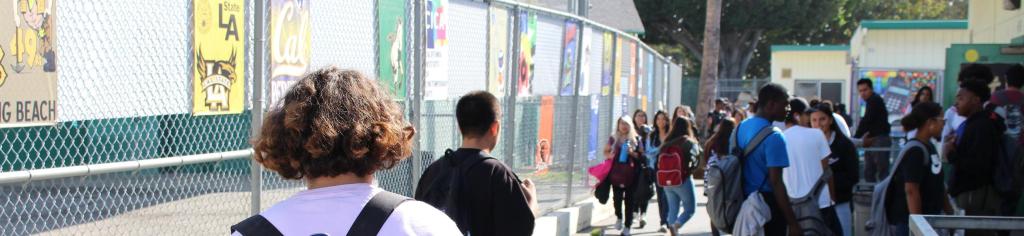
Whenever I walk onto a school site, I immediately get a sense of its culture. After more than three decades in education, I know what to look for. My radar is finely tuned. Through witnessing a combination of verbal and non-verbal communication, the overt and subtle behaviors, I get a very clear sense of how students and staff are among and with one another. I can detect how cohesive the staff and students are when they are interacting in formal and informal settings. When observing students, I can see if they have healthy or toxic connections with one another and the staff. All of this matters because the culture of a school has a far-reaching influence on its mission on educating students and preparing them for life. What drives a school’s culture are the philosophy and values it’s foundation is built upon. Your values are the things that you believe are important in the way you live and work. Values set the tone, determines expectations and sends signals for what is and isn’t tolerated.
Now, I don’t claim to be clairvoyant. Obviously over time, deeper insights into how a school really operates will emerge. But I don’t need a lot of time to form an initial impression. Questions I ask myself include: Do I feel welcomed? What is the degree of warmth and kindness (or lack of it) the office staff projects when encountering them? How genuine are interactions? Do students seem relaxed and free to be themselves or are they stressed, wearing their “armor” with looks of distrust and are closed-off when approached? Is there a general sense of community and belongingness exhibited or is there an unnerving energy and underlying unpredictability that makes one feel like you stepped into a low security prison and everyone is anxious to leave? How engaged are students in the learning process? Do the staff spend most of their time complaining or saying positive things about their workplace and those in it?

Schools are a natural and indispensable space where our nation’s youth to acquire core human values. These values are essential life skills. A social lubricant, if you will. But with our society so divided and polarized along racial, socio-political, and economic lines, it is all that more important to expose and inculcate core values that everyone can agree on.
Some may argue that it is too much of a risk to teach and promote values in a public-school setting. But I believe that we do students a disservice (as well as society in general) if we don’t. Because schools are repositories of all social ills, there are countless, daily opportunities where that “teachable moment” of imparting, nurturing, and reinforcing values present themselves.
Students are yearning to be in school environments where they feel physically and psychologically safe and cared for. Research has shown that when students have at their school one supportive and caring adult and/or a consistent and structured milieu, it can prevent psychopathology to manifest. Even though the acquisition of values starts at home, it finishes with us at school. Moreover, students may or may not be given proper guidance and values lessons at home. Many families are struggling to put food on the table or don’t have the wherewithal to be effective parents 100% of the time. The fact that kids spend more time away from being under their parents supervision when they enter into elementary and secondary schools, it logically follows that part of their education away from home is to learn how to share and co-exist with others in order to be a part of a learning community at school and ultimately when they matriculate into life on their own.
Every school, whether intentional or not, has a philosophy that says “This is the way we do things around here.” My goal as a teacher and Principal was that the staff got along with one another, worked through conflicts and differences in a professional and respectful manner, and had empathy and high expectations for each and every student who was under our care. For students, I wanted to create an environment that made each one feel that they belonged, that they would treat each other with respect inside and outside of the classroom (especially when the adults were not around), to have compassion for one another, and to question authority when appropriate so they had positive non-judgmental experiences to think for themselves but always have gratitude for the gift of education that the school staff was providing them. But these goals could only be realized when the faculty and students had a shared vision.

All schools are constantly promoting a set of values, consciously or not. Whether those values are aligned to the students and staff’s best interest and to what extent they are formalized, depends on the community the school resides in, it’s school leadership, and the autonomy it is granted by district officials. Schools that attempt to impact its school with an agreed upon set of values and programs that help shape the non-academic aspect of students’ lives realize that it’s not all about grades, GPA’s, high stakes testing, and college acceptance letters, etc. While all things related to instruction do matter and are consequential, its the schools’ that help integrate values and build positive character in students that really make a difference and have a staff that goes the extra mile. What they are saying is that they are in the business of teaching students how to be well-rounded human beings.
There are many values to choose from but its best to go with those that don’t pose any controversy and that everyone can agree on. They transcend one’s political viewpoint, racial & ethnic background, gender, education level, geographic location, socio-economics status, etc. The five foundational values that I found easy to promote are:
- Respect
- Honesty
- Responsibility
- Fairness
- Empathy
These values can be prioritized, depending on what issues they can help address for each school. All of them are relevant with some having greater emphasis needed than others. The key is knowing that in whatever form they are used, they remain consistently applicable across groups, communities, and nations. You may have your own set of values that you want to promote. All that matters is that they are easily articulated and that you are willing to execute them into action.
All of these values fall under the umbrella of ethical decision making. Don’t we want our students to ask themselves: “How do my words and actions impact others?” They guide students’ in their relationships and in their responses in all of their life’s situations. But if we want to teach and impart these values to students correctly, we have to think both strategically and tactically. We can’t impose or force these values on them. It is better to offer them as a framework and guide them into learning what they are, why they exist, what are the consequences if we act in an opposite way, and how they can benefit from them. Having a range of ways to tap into values teaching is important. Discussions, engaging activities and lessons are critical. However, adults modeling these behaviors is the key. We need to match words to actions. Students have finely-tuned hypocrisy radar detectors and will reject attempts to teach and reinforce values if the adults are not practicing them or are in fact violating them.

Students can learn how to consciously make an ethical decision if they are given opportunities to practice them. We can teach respect for others and oneself. Honesty creates trustworthiness and integrity and rubs up against the current trend of lying that political figures display along with misinformation and disinformation. Teaching responsibility helps students in their “ability to respond” and the benefits of keeping their promises and following through behavior. Fairness helps students understand that the world doesn’t always treat people in the same and equal way. We can teach students that caring and having empathy for others, seeing everyone as having something worthy and redeeming, and to reach out for those less fortunate, is a virtue and a gift to oneself. Many of these values impact each other. If I respect others that means I wont be late. Teaching citizenship helps students learn that they have a role to play in our democracy. They can voice their concerns and preferences, participating in a variety of political activities, and respecting the rights, beliefs, and opinions of others. Active listening is also a sign of respect as is showing good sportsmanship after losing a contest. Helping the teacher with certain tasks is a form of responsibility. Forgiving someone and not taking it personal when they make a mistake and cause a problem for others. Ultimately, when students align positive values with their behavior, the message we are sending to them is that they have no right to interfere in the rights of others in their pursuit their education. These are real-world experiences where students can prepare for their future behavior and roles in society.

So, how best to integrate these values in the school’s milieu? In order for the entire school to internalize and practice these values, I coined the phrase ‘The HArts Way.’ HArts, my former school, is an acronym that stands for Humanities and Arts Academy of Los Angeles High School. In essence, when coining the phrase “The Harts Way,” it reflects the school’s philosophy. It’s another way of saying “It’s the way we do things around here.” When you attach the term ‘The ________Way’ to your school, it encapsulates a wide range of behaviors, expectations, and standards. It becomes embedded into the consciousness of all stakeholders, even parents and district officials who are familiar with the school, as the phrase comes up in numerous and consistent conversations, becoming part of the school’s lexicon, helping to give life to the school’s identify within the community. Eventually, The ___Way becomes associated with virtually everything the school accomplishes and is rooted in its legacy.
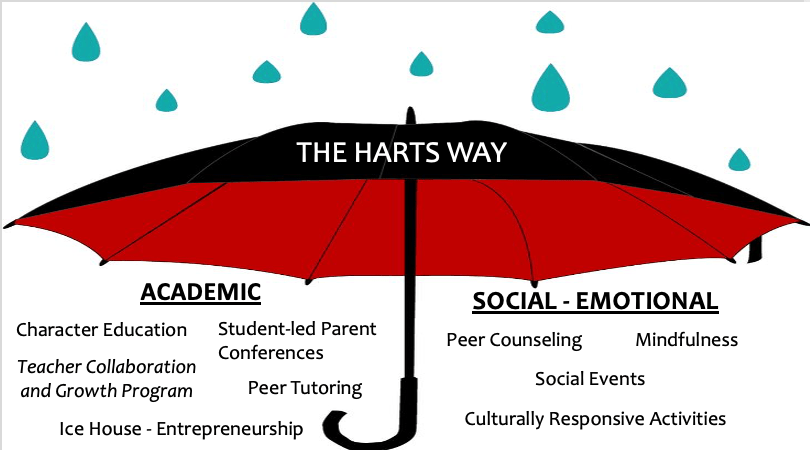
There are formal and informal components that it comprises. Each component is divided into an academic and Social-Emotional dimension. Each one acts as a moral compass and gives direction to help everyone make choices that are in the interests of each individual and the school community. Collectively, they mitigate all of the negative forces that try to penetrate a school. The following is a list and description of school structures that teach students and staff who we are and how to be:
- Character Education: This is a curriculum that can be added to an Advisory class, supplemental curriculum in English or Social Studies classes, or a stand-alone required class for a specific grade level. There are many programs out there that promote values. We used The Ice House – a community college curriculum for all 9th graders to help them learn how to develop and entrepreneurial mindset where they learn concepts including react vs. respond, locus of control, and the process for solving their own problems. Being a freshman in high school is a life altering experience and program that help them become self-aware and maturate aides in their transition from middle school to high school.
- Student Assistance Program: Get students involved in a very direct and purposeful way by creating a Peer Counseling Program that provides emotional support for students and a Peer Tutoring Program that has students helping provide academic support for students struggling in a variety or subjects. Both of these programs place students in leadership roles and lets all students know that they are there for each other in the most meaningful ways.
- School Wide Events: Create an event dedicated to raising awareness of, and celebrating, the practice of values. You can incorporate a culturally responsive event that celebrates cultural diversity at your school (e.g., Multicultural Day – Have students take over the instruction for a day and provide teacher-guided presentation surrounding the theme of culture and values.)
- Professional Development: Ensure that the school staff have professional development opportunities to help them assess their own cultural viewpoints and biases, set high expectations for all students, acknowledge diverse learning styles, use culturally responsible pedagogy, and effectively engage diverse families and community members.
- Mindfulness: Ask your teaching staff to implement a meditation protocol into their classes. This is voluntary and can be a few minutes at the beginning, middle or end of a class. This helps students learn to train their attention to the present moment to create a sense of calm. Student can use it to control their impulses and tolerate frustration. It provides many physical and psychological benefits. Coming into a classroom after being at nutrition, lunch, or another class, students can be amped up. This helps them self-regulate and relax which, paradoxically, allows them to have more concentration power.
- Social Events: School-sponsored events like concerts in the garden after school, dances, celebrations during lunch, and other activities that allow students to have fun with one another helps them learn how to have a good time while practicing all of the values that the school is promoting. They cultivate the experience of being with each other in the right way and are rewarded for their behavior at the same time. It’s the school’s way of saying we enjoy each other’s company and thank you for being you.
- Parent-led Conferences: Students take more ownership of their learning. Parents and students have open communication about school, after-school activities, and other important decisions in life. Teachers establish a stronger working relationship with parents and students.
- Economics: Every student needs to know that they are the best resource that they will ever have. That their human capital is their meal ticket. Their future career, income and wealth (or whatever they determine as fulfillment) is entirely dependent on the totality of their skills, knowledge, and experiences. Hence, with Economic Reasoning, students come to gain deep insight on why they are in school which is to work on themselves and build their human capital. Instead of being passive recipients in the learning process, they are active and engaged on a daily basis, using the tools of Economic Reasoning (benefit-cost analysis, marginal thinking, scarcity, opportunity costs, etc.) to make informed decisions with scarce resources (most importantly themselves) in order to accomplish their goals. These concepts should not be taught only in a stand alone 12th-grade Economics course but throughout elementary and secondary grades. The power of these Economics principles, if used and taught effectively, has the ability save and improve lives. Integrate this Economic Way of Thinking into various curricular opportunities (Advisory, Social Studies courses, etc.) and you will be giving a tremendous gift to your students.
- Teacher Collaboration & Growth Program: This has supplanted our formal Teacher Evaluation program mandated by the district. Teachers engage with one another in Department and Grade level Teams discussions, and participate in Peer Observations as they observe lessons in their colleagues’ classes and provide effective feedback. Better conversations, professionalism, and increased staff morale are benefits from this program. The values mentioned above are practiced and internalized. When the staff engages with one another in a supportive and professional manner, they become more cohesive. Their bonds, connections, and professional behavior are observed by students daily which has a nurturing and positive role modeling effect on them.

There are multiple benefits when intentionally making values a part of the students’ whole learning experience. They include:
- Help strengthen a school’s culture and level of cohesiveness. Students and staff reflect on their attitudes and actions.
- Students acquire essential life skills that help them in their relationships, developing a positive self-image, and help students identify their values. Moral values are carried and lived out for a lifetime.
- Students develop their social and moral character and prepare them to be responsible, global citizens who are kind and considerate toward others. This helps prevent the spread of dishonesty and violence in society.
- Students realize that intelligence is not enough. That intelligence plus character is the goal of education.
- Students and staff view the school as a sanctuary. A space that is psychologically safe and a workplace to be cared for. There is less acting-out behavior as a result.
- When the student population is given a foundational set of values to guide them, their behavior is more goal-directed and enhances acquisition of the instructional program. Student achievement increases across the board and affords students the tools to be more resilient.
- Teachers are dealing with less acting out or undesirable behavior that interferes with the learning process. This decreases burnout and increases teacher morale.
- Using ‘The ___ Way’ becomes so central to the school’s identity, you can showcase it during the WASC accreditation process or any other formal presentation, recruitment, or evaluation.

Intuitively, I knew that The HArts Way was being internalized by students. But it was confirmed one day when, as Principal, a student approached me and began to talk about an interaction he had witnessed between a teacher and another student during lunchtime. The teacher apparently made the mistake of confronting one of her students in a way that made them feel ashamed. He was troubled by what he saw. The student relaying the story to me closed by saying with a genuine look of disappointment, “Mr. Fisher, that’s just not The HArts Way.” I knew in that moment that this catch-all phrase and its accompanying set of values was in the hearts and minds of every student. It was confirmation that our goal of helping students think before they act, try to do the right thing, and help them evolve as caring and responsible human beings, was moving in the right direction. There is no better way to unify a school community when all behavior and conversations are grounded in ‘The Way.’
You can contact Greg Fisher at schoolempowerment@gmail.com
 School Empowerment Group
Leave a comment